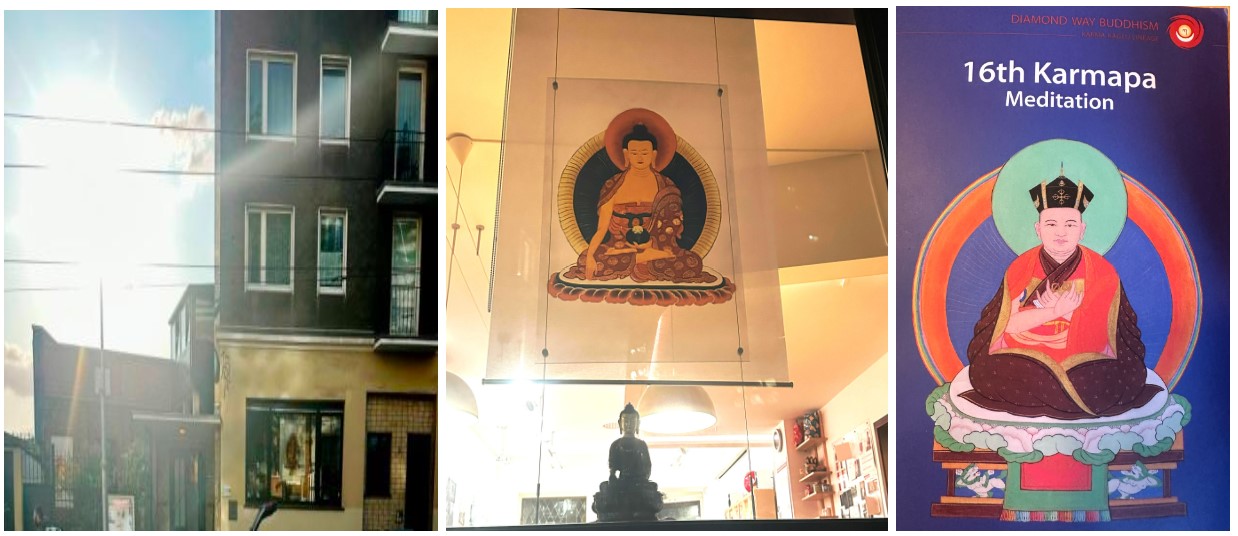
Buddhist Center Düsseldorf is located at Unterbilk. This center is established as a meeting point for those who are interested in Buddhism and get explanations about meditation from experienced Buddhist practitioners. The main purpose of the center is to provide open access to the method of Diamond Way Buddhism. This center was established in the initiation of Lama Ole Nydahl and his wife Hannah, Lama Ole Nydahl, a Western Buddhist born in Denmark, established Diamond Way Buddhism in the 1970s, together with his wife Hannah Nydahl. They both worked since the 1970s to translate and spread the Karma Kagyu lineage of lay Tibetan Buddhism in the West. After several years in the Himalayas learning and traveling with the 16th Karmapa Rangjung Rigpe Dorje and other Tibetan meditation masters, Lama Ole Nydahl and his wife Hannah set off back to Denmark. After having stayed and followed the path Karmapa, Karmapa authorized them to promote and teach the Vajrayana teaching in the West. Thus, in 1972 began their journey of bringing Buddhism to the West. They founded Diamond Way Buddhism for lay students of Karma Kagyu Buddhism, which is now one of the most widespread Buddhist schools in the West. Diamond Way Buddhism belongs to the thousand-year-old Karma Kagyu lineage of Tibetan Buddhism. Their main teacher, the 16th Karmapa asked them to teach what they had learned and to start Buddhist centers in the West.
More than 40 years later, there are now 640 Diamond Way Buddhist centers around the world. The meditation methods that these centers are all traditional Buddhist teachings, but adjusted according to modern style, giving access to all. Lama Ole has taught a number of students as a lay Diamond Way Buddhist teacher with his long experience. He gives practical explanations about Buddhism in Diamond Way centers. Thaye Dorje, His Holiness the 17th Gyalwa Karmapa, and other high Buddhist teachers such as Sherab Gyaltsen Rinpoche and Lama Jigme Rinpoche visit Diamond Way Buddhist centers and teach and conduct a large meditation course.
Activities
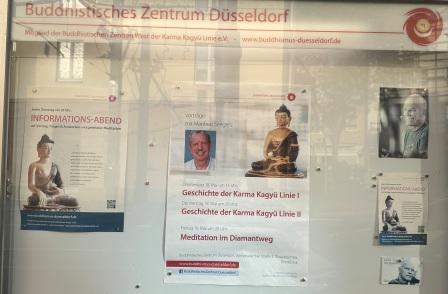
The Diamond Way Buddhism Foundation coordinates international cultural and academic initiatives. It offers support and expertise to Buddhist centers and projects. Diamond Way Buddhists often travel to different countries and centers, to see their teachers and meet with other practitioners. The central international place where this enriching human exchange happens is the Europe Center, which was bought by the Diamond Way Buddhism Foundation in 2007. The Europe Center consists of several buildings and 50 hectares of forest and meadows in the beautiful setting of the Bavarian Alps in Germany. All Diamond Way Buddhist centers and organizations are run on a voluntary basis and supported by personal donations, center memberships, and profit from Buddhist courses, lectures, and books.
#### Buddha statue in the meditation hall
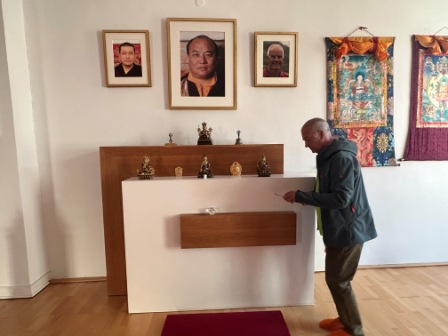
The real connection where people are attached to the center because of ritual objects and spaces to the Buddha, how they place it, and how much importance they give. The importance of aesthetic beauty in a hall helps to create the overall atmosphere and functionality of the space in connection to the original place. It creates a positive first impression for visitors and devotees. People tend to feel more comfortable and at ease in aesthetically pleasing environments. In order to reflect aesthetic identity in the hall, in the center of the hall
In order to reflect aesthetic identity in the meditation hall, there are several pictures of lineage teachers and religious images and objects. It is convenient to identify which type of meditation center and what is taught there. Even though this center is a Mahayana Buddhist center and in the Mahayana tradition, the center especially focuses on Karmapa teacher’s schooling tradition. So, in order to show their belongingness and specific identity, the center has displayed common images and statues. Therefore, the main meditation hall highlights 16th Karmapa lineage teachers. In the center of the hall certain kind of altar was created, The Shakyamuni Buddha statue was placed in the middle of the altar, then on the left side Goddess Tara statue, and on the right side Maitreya Buddha statue was placed. On the above layer, Karmapa statue with vajra and bell was placed. In order to show the affiliation, the image of 17th Gyalwa Karmapa is placed on the right side 16th Karmapa, Thaye Dorje. Founder Lama Ole Nydahl’s picture was placed on the left of the 16th Karmapa.
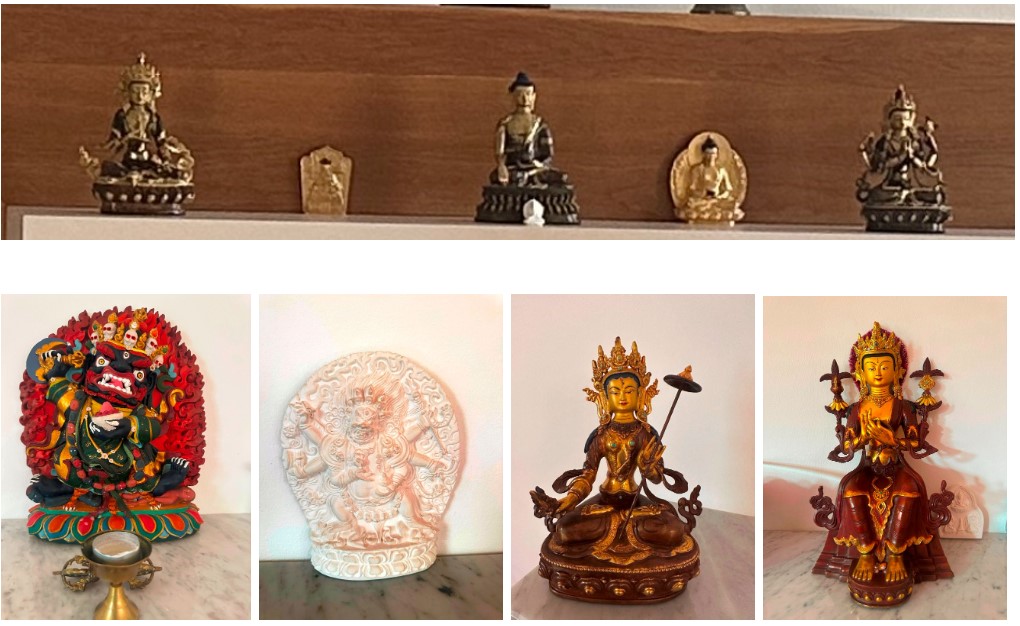
Most statues and motifs that were displayed in the meditation hall belong to Nepali arts and sculpture. According to historical background, Nepalese sculpture is a sequential-developed art form of the Gupta art period in India and later was enhanced by Pala dynasty art in India. In the time of the Malla and the Lichhavi period, Nepali art and architecture flourished. By that time, Nepalese sculptures had domesticated art in their tradition by developing their own unique style and characteristics. Nepalese sculpture demonstrates a creative and distinctive approach to depicting religious and mythological themes. Nepalese artists later developed a distinctive physiognomy for their deities, with long, languid eyes and wider faces than those in Eastern Indian models. A tendency toward ornamental flourishes, exaggerated postures, and a repertoire of unique jewelry styles is also symptomatic of the Nepalese sculptural tradition. When we analyze the Buddha statue of Nepal, most Buddha statue is seen, Buddha sitting on the lotus seat. According to Ananda K.coomarsamy this is a non-Indian tradition normally in the Mathura tradition Sakyasimha or Tathagata Buddha is represented in Lion’s seat but in the Gandhara tradition Buddha is shown in padmasana or in the lotus seat. If we accept these facts, then Nepal Buddha sculpture is highly influenced by Gandhara tradition.
References
[^1] Ananda K. Coomaraswamy, The Origin of the Buddha Image, The Art Bulletin , Jun., 1927, Vol. 9, No. 4 (Jun., 1927), pp. 287-329 Published by: CAA Stable URL: https://www.jstor.org/stable/3046550
[^2] Brown, Kathryn Selig. “Nepalese Sculpture.” In Heilbrunn Timeline of Art History. New York: The Metropolitan Museum of Art, 2000–. http://www.metmuseum.org/toah/hd/neps/hd_neps.htm (October 2003)
[^3] https://www.buddhism-foundation.org/about-the-foundation