Buddhist Centres and their Buddha Statue heritage in North Rhine Westphalia
a template for creating simple digital exhibits
Contents: About the Collection | About the About Page | Tech
About the Collection
========================
This digital exhibit focuses on three different traditional Buddhist centers located in the North Rhine-Westphalia of Germany. Here I want to show the existence of different Buddhist schools in Germany and my primary subject is the Buddha statue and their heritage, besides that, I would like to highlight their adherent, the surrounding atmosphere, as well as their other activities. As a showcase, I presented a variety of photographs taken by me from the Buddhist Center of Düsseldorf, Wat Buddhasamakkee Duisburg, and The EKO-Haus der Japanishchen Kultur e.V, Düsseldorf. In these photographs. I want to show the outer look of the Center,
How the praying hall are arranged? What are the unique things they kept in their main hall? How do they try to link with their origin place? How much importance is given to aesthetic beauty? What are the decorative objects? Who are their main targeted groups? How do they attract new visitors?
In order to make this project successful, I visited all three places and participated in their program and also interacted with some people, and then observed there. Personal experiences Before starting the project, it was simple. As I thought, temples and centers were public places, and we could have easy access, but it was right opposite. I have to make an appointment in advance before visiting a temple. I experienced that in some places they don’t like to welcome strangers. Another uncommon thing, I encountered during my visit was when someone new stranger went to the center they behaved suspiciously whether they had come to gather hidden information. I found here in the temple, some center authorities don’t like to share information about their temple, they behave like a suspicious person. However, some temples are very positive and welcome as a relative, they want to share about their centers and their activities and also encourage to be a regular participant. While working on this project, I gained a lot of knowledge about Buddhism and its belief system. I chose three different schools as a representation of each thought, one from the Theravada tradition another from the Mahayana tradition, and the final one from the Zen tradition.
Although these three traditions follow the same Buddha and His teachings, there are dissimilarities in understanding and perceiving Buddha and his teachings. In this project, my objective is to show the importance of Buddha statues where these statues’ original art and manufacture belong their belonging in their centers, and how their followers give priority in terms of space as well as worship.
Theravada Tradition
I chose Wat Buddhasamakkee at Duisburg as the Theravada Buddhist tradition representation. Theravada’s school of thought believes in elders’ taught doctrine without modification which comes from generation to generation starting from Siddhārtha Gautama Buddha and then his followers and disciples to present day existing Sangha or Bhikkhu Union. In this tradition, they perceived Buddha as a normal human being and after several austerities of practices and failures only he had achieved enlightenment and became a Supreme Buddha. So, in this tradition, an Image or statue of Siddhārtha Gautama Buddha has been given a more prominent place than other figurines. In most Theravada temples, the Sitting Buddha statue with half covered shoulder robe seems familiar and is placed in the centre of the main hall. When you enter the Wat Buddhasamkkee main worshiping hall, many Buddha statues are placed for veneration, there, an image of Buddha has a similar and unique standard of art which is common to the Thailand Buddha statue. It would be easily recognized that this style of art belongs to Thailand. Along with Buddha statues, other cultural and ritual objects kept bringing Thai cultural vibes. There is also a Thai monk in the center for performing religious activities. Thai community living in Germany supports and funds to run the temple. In this temple, people gather and celebrate Thai culture. This temple gives a home-like feeling to the Thai people who are living around North Rhine-Westphalia, Germany.
Mahayana tradition
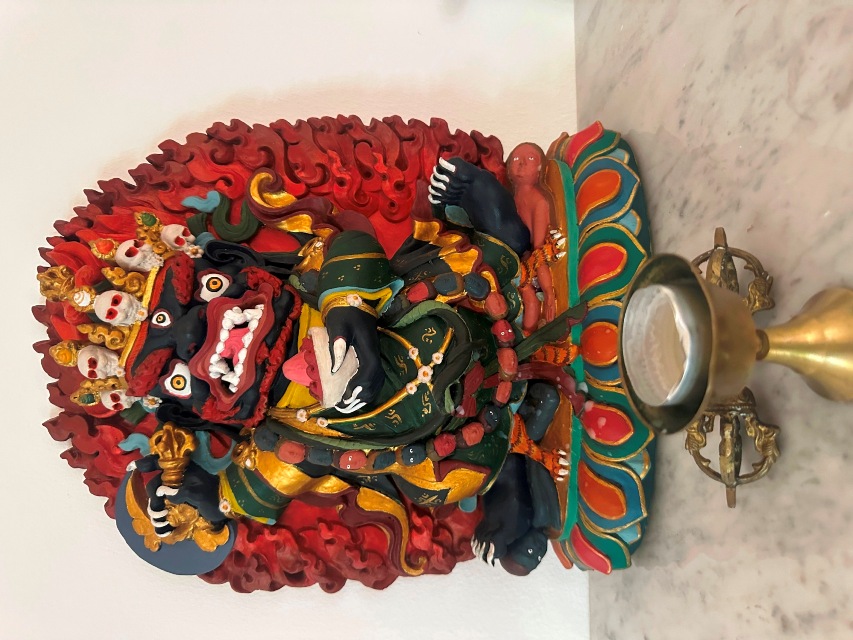
The Mahayana Buddhist tradition is considerably liberal as compared to The Theravada tradition. With time, they interpret them as Mahayana (large vehicles) because according to their school thoughts in the Theravada tradition everyone cannot be supreme Buddha only one can become enlightened who has completed the ten perfection. And Buddha hood is also limited to certain numbers. So, they came up with the concept of numerous enlightenment in the Maitreya Buddha. In this school of thought, Maitreya Buddha worship has prominent role than Siddhartha Gautam Buddha. Mahayana Buddhism is also linked to Tibet because Mahayana Buddhism was widely spread and the foundation of Mahayana teaching is strong in Tibet. Another key factor of Mahayana is based on the teacher’s followers and belief in repeated incarnations of the same teacher at different birth. There are the most prominent teachers like Dalai Lama, Karmapa… These Great Lama are famous and popular in the world and both belong to Tibet. So, the Mahayana Buddhist tradition is also well known as Tibetan Buddhism. As a representation of the Mahayana tradition, I have selected the Buddhist center in Düsseldorf. Even though from exterior does not match a temple building, the center tries to give the feeling of a meditation center by decorating the hall with deities sculptures, Thankga, paintings, images, pictures of masters, and religious objects. There were seats arranged for Meditation. I got a chance to participate in the session. There, I saw a number of new visitors who paid interest and joined the program. Besides meditation practice, they have organized a talk program with a guest speaker about basic concepts and their Buddhist practices. After a talk and discussion session, Meditation was started according to the Karmapa techniques, which were a little bit unfamiliar to me. But it was also a new experience for me, Participants were given the task of recalling and feeling the picture of the Karmapa Statue. There was also the Shakyamuni Buddha statue as well as the Maitreya Buddha Statue, but the main focus in the Buddhist center was Karmapa and his lineage teachers. As the traditional founder teachers are from Tibet, it depicts Tibetan tradition and has to chant in Tibetan language. But overall, statues and sculptures were made and brought from Nepal. Because Most of the Tibetan Mahayana Deities and Buddha are manufactured by Nepalese artists. Which is quite unique compared to others manufactured from Bhutan and China.
Zen Buddhist Tradition
Zen Buddhist tradition is famous as Japanese Buddhism. Even though Zen Buddhism is considered a branch of Mahayana Buddhism, religious practice and philosophical thoughts are slightly different compared to the main Mahayana school of thought. Zen Buddhism is more focused on self-awakening through the continuous practice of meditation. They believe that this teaching directly came from Shakyamuni Buddha himself to Mahakasyapa and to his followers. But the belief in Amitabha who is the upcoming Buddha now residing in Sukhawati heaven. Zen Buddhism is very popular in the West because of its simplicity and straightforwardness in grasping reality and acting on it “here and now,” In other to get deep insight about Zen Buddhism and Japanese culture I chose EKO-Haus der Japanishchen Kultur e.V, in Düsseldorf, which gave vibes of entering Japan in Germany. In this cultural center, they have built a huge shrine hall and cultural center museum to display Japanese culture. All the religious activities were performed in the main shrine hall, and there were chair arrangements for participants in the middle of the hall there was a standing statue of Amitabha Buddha and a side with Lineage Masters pictures. Here too I joined one of the programs, the atmosphere was good and visitors from different nations were welcomed. In the center, I encountered one German priest and two other Japanese priests. With surrounding Japanese architecture and Japanese people, it gives a feeling of being in Japan. The Amitabha Buddha in the main hall depicts all the features of Japanese art. While doing this project, it was great learning about the art of different countries and even the religions that belong to Buddhism, but the attraction of interest and art is the same Buddha had dissimilarity. Finally, the main lesson of this project is object is the main source to identify the heredity and origin.
Reference:
- Ananda K. Coomaraswamy, The Origin of the Buddha Image, The Art Bulletin , Jun. 1927, Vol. 9, No. 4 (Jun. 1927), pp. 287-329 Published by: CAA Stable URL: https://www.jstor.org/stable/3046550
- Baumann, Martin, 1996, Buddhism in the West: Phases, Orders and the Creation of an Integrative Buddhism, Internationales Asienforum, Vol.27. No. 3-4.p. 345-362 Brown, Kathryn Selig. “Nepalese Sculpture.” In Heilbrunn Timeline of Art History. New York: The Metropolitan Museum of Art, 2000–. http://www.metmuseum.org/toah/hd/neps/hd_neps.htm (October 2003)
- Jørn Borup,_Buddhism in the West, Department of Culture and Society, ARTS, Aarhus University, Aarhus C, Denmark
- Linda Marlinda, Fikri Budiman, Ruri Suko Basuki, Ahmad Zainul Fanani, Comparison of sift and orb methods in identifying the face of the Buddha Statue_. Doctoral Program Of Computer Science Faculty1,3,4,5 Universitas Dian Nuswantoro, Semarang.
- Moriya Tomoe, 守屋 友江, (1936), _D.T. Suzuki at the World Congress of Faiths, _An Analysis of His Presentation at the Interfaith Conference__, Nanzan Institute for Religion and Culture, Nagoya, Japan
- Sawitree Wisetchat. Visualizing the Evolution of the Sukhothai Buddha, pg 572
- Suzuki, D.T., 2010, Zen and Japanese Culture, Princeton: Princeton University Press.
- Yifan Zheng, A Study of the History of the Development of Buddhist Iconography, Arts and Crafts Department, Beijing City University, Beijing,101309, China
- https://brill.com/view/journals/jrj/10/2-3/article-p135_2.xml
- https://www.christies.com/en/stories/age-of-enlightenment-an-introduction-to-early-japa-25d8696b4fdb4b92ae1471bf4ccd23da
- https://eko-haus.de/en/about-us/purpose-history
- https://www.diamondway-buddhism.org/buddhist-teachers
- https://www.sanghaoceania.org/en/aboutus
About the About Page
We want to make engaging interpretive pages easier to create, so CollectionBuilder gives you tools to write with your collection content!
The template comes with a customizable “About” page layout designed for long form content with rich media embeds. Content is written in Markdown and enhanced using “includes” that pull in collection content, external media, and Bootstrap features like cards and modals. We hope this makes it easier for site builders to develop the collection AND add interesting and engaging contextual information.
Each “include” file has several options, which are documented in the files themselves–copy the examples to see how it works with your content! In the demo below, we’ve given display widths of 25% and 50% to save space, but you can feature the entire image or document.
You can also see a page featuring a bonanza of feature includes options on our CollectionBuilder-GH demo site.
Include Collection Items
The template provides includes to pull your collection objects and metadata into your interpretive page, allowing you to write with your materials directly embedded in the content.
Include an Image
- Image –>
{% include feature/image.html objectid="demo_001" width="75" %}
Include a PDF
- PDF – >
{% include feature/pdf.html objectid="demo_002" width="50" %}
Include a Video
- Video:
{% include feature/video.html objectid="demo_004" %}
Include an Audio File
- Audio:
{% include feature/audio.html objectid="demo_003" %}
Include Bootstrap Features
The template also provides includes to make it easier to add Bootstrap components to your Markdown writing. These features allow you to better organize and highlight your content.
Include a Card
- Card – >
{% include feature/card.html header="This is a Card" text="The card features an image from the collection as a cap" objectid="demo004" width="25" centered=true %}
This is a Card
The card features an image from the collection as a cap
Include a Button
- Buttons – >
{% include feature/button.html text="Button Link to Somewhere" link="https://collectionbuilder.github.io/" color="success" %}
Include an Alert
- Alerts – >
{% include feature/alert.html text="this is an *alert* that 'warns' a user" color="warning" align="center" %}
This is an alert that ‘warns’ a user with centrally aligned text.
Include a Modal
- Modals – >
{% include feature/modal.html button="This is a modal using a 'primary' colored button to invite clicking" title="when clicked:" text="A Modal will pop out a box with some more information" color="primary" %}
Technical Credits - CollectionBuilder
This digital collection is built with CollectionBuilder, an open source framework for creating digital collection and exhibit websites that is developed by faculty librarians at the University of Idaho Library following the Lib-Static methodology.
The site started from the CollectionBuilder-GH template which utilizes the static website generator Jekyll and GitHub Pages to build and host digital collections and exhibits.